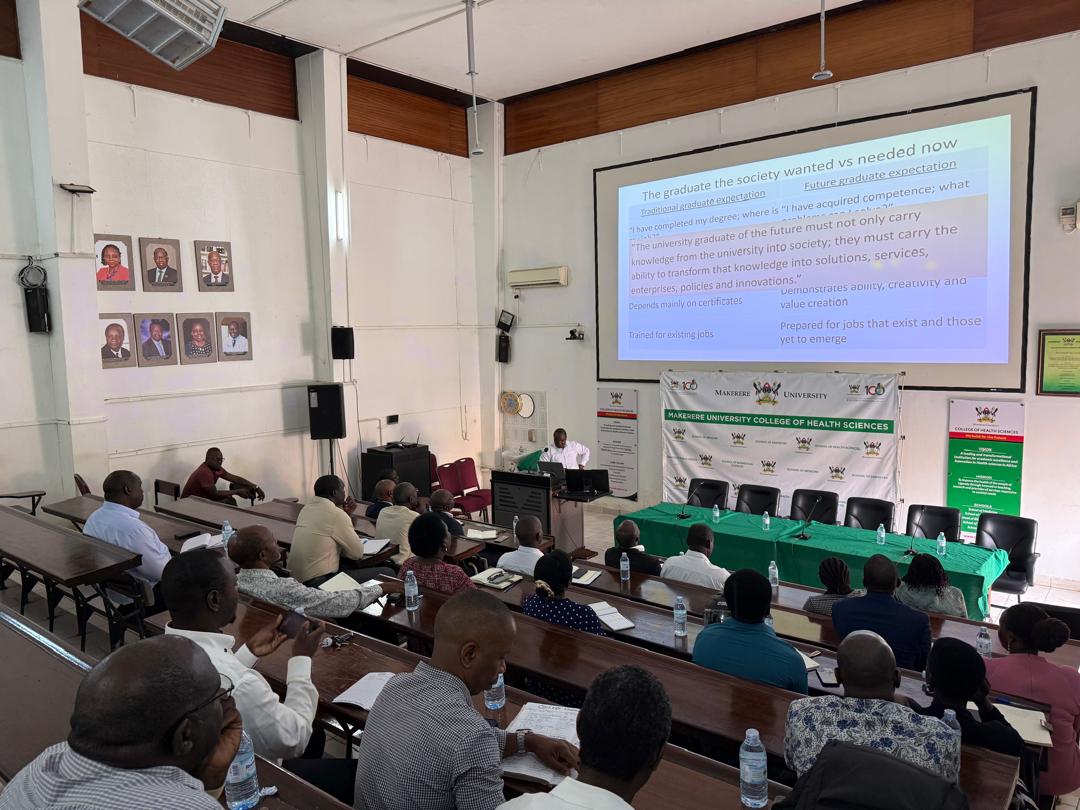
The Makerere University Directorate of Quality Assurance (MakDQA) held a curriculum mapping meeting for Competence-Based Education and Training (CBET) with staff of the Makerere University College of Health Sciences (MakCHS) as the University prepares to implement revised competency-based curricula effective 2027/2028 academic year.
The meeting, held on Wednesday, 16th September 2026, focused on strengthening the College’s capacity to align its curriculum, teaching and learning activities, assessment methods, and expected graduate competencies with CBE principles.
Welcoming staff to the meeting, Professor Richard Idro, Deputy Principal-MakCHS highlighted the tight timelines to align with the directive from the Minister of Education and Sports regarding competency-based education effective academic year 2027/2028. He noted, “This exercise is essential in ensuring that our curriculum, teaching, learning, and assessment are aligned with the competencies required of our graduates. However, the timelines are tight to ensure that our curricula are accredited within the limited period”
The initiative forms part of Makerere University’s response to the Government of Uganda directive to Higher Education Institutions (HEIs) to enhance the quality and relevance of academic programmes and transition towards more competence-oriented teaching, learning and assessment. The initial focus will be on undergraduate programmes, in line with the Ministry of Education and Sports directive, implemented through the National Council for Higher Education (NCHE), for universities to adopt competency-based curricula.
During the meeting, participants explored curriculum mapping as a tool for aligning programme and course learning outcomes with teaching strategies and assessment methods. They also examined how the existing MakCHS programmes could be mapped against the competencies expected of graduates.
Director of MakDQA, Dr. Cyprian Misinde, urged staff to take the transition seriously and adhere to approved processes, standards and timelines in curriculum development and implementation. “Effective implementation requires careful planning, appropriate programme design and a deliberate focus on equipping students with the knowledge, skills and competencies needed for professional practice,” Dr. Misinde said.
He noted that curriculum mapping helps academic units identify gaps, overlaps and areas requiring improvement while promoting quality, consistency and continuous enhancement of academic programmes.
The interactive session also provided an opportunity for staff to discuss challenges associated with introducing a competency-based curriculum at MakCHS.